

The Danish Space sector go above and beyond
The Danish Space sector go above and beyond
With increased funding, fast growing start-ups and lead on international missions, Denmark is ready to cement itself as a hub for space industry.
With increased funding, fast growing start-ups and lead on international missions, Denmark is ready to cement itself as a hub for space industry.
Denmark's involvement in space activities dates back to the 1960s and international cooperation primarily through our membership in the European Space Agency (ESA) has been pivotal in shaping the Danish space strongholds. Denmark was among the countries that founded ESA in 1975, and since then, the nation has actively participated in numerous projects, primarily focusing on Earth and climate development observations, satellite technology, and scientific research.
The Danish space sector has a long history driving innovation particularly via the research taking place at the national universities. Denmark has developed a significant presence in the global space community by being a leading player in several key technologies such as microsatellites, sensors, radars, precision navigation and star trackers, and downstream applications to survey geographical data and monitor climate change.
As an example hereof DTU Space recently demonstrated that by using AI and their advanced camera and navigation technology, satellites can now all by themselves maneuver and maintain formation with extreme precision – without any assistance from Earth, which you can read more about here.
From public side the space effort is supported by the Danish universities that play a crucial role in advancing space science and technology through research and education. The universities also participate in international research projects, fostering innovation and transfer of knowledge. To ensure that the new research actually finds usage in the real world, the education institutions collaborate with industry partners and the ESA Business Incubator Program (ESA BIC) has now been expanded so the four Universities all participate and help companies in Denmark stay competitive in today’s rapidly changing space economy. The program offers a unique package of free consultancy services, technical expertise and B2B matchmaking that enables companies to build a strong business case with space and secure funding for the innovation of space technology.
Denmark is home to a growing number of firms specializing in satellite technology, remote sensing, and data analysis. Notable examples include large companies such as Terma, which develops satellite components and radars, and smaller more recently started companies such as GomSpace, Space Inventor & Sternula all of which are known for their innovative micro satellite solutions. As recent international activities have made upstream activities significantly cheaper and more accessible it has paved the way for these Danish companies to be able to access space easily and thus progress in their efforts to send up their satellites and provide downstream services globally.
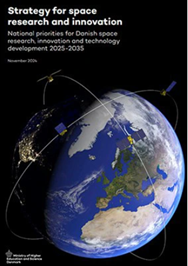
The new strategy for space research and innovation can be accessed here
With the first dedicated strategy for space research and innovation launched in the end of 2024, the government has identified space as a key area for innovation and economic development, and has doubled the funding for Danish and ESA projects. The strategy also introduced a new national program within Innovation Fund Denmark, where foreign partners can participate and receive funding for R&D together with Danish companies. With the strategy Denmark is committed to enter into even deeper international space partnerships and the Ministry of Foreign Affairs of Denmark through our Innovation Centres, is currently active all over the world and are working to enter further agreements with both foreign governments, academia and private corporations.
Looking to the future, the Danish space sector aims to further expand its role in international space exploration and scientific discovery. In 1999, Denmark launched the Ørsted-satellite which has been vital in mapping earth’s magnetic field and now Denmark is looking to lead a new major project with an application to lead the moon mission ‘Máni’ through the ESA. The mission aims to create multi-angle photometric observations of the moon, which could be of great importance for future manned missions to the moon, as the mission intends to achieve unprecedented resolution and detail of the lunar surface.
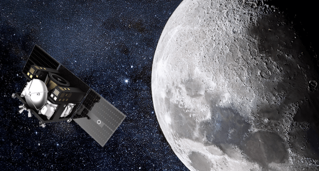
Visualization of the Máni mission from Copenhagen University
If you are looking to know more about the Danish space sector, Invest in Denmark always stand ready to introduce you to the domestic ecosystem and introduce you to relevant space conferences taking place in Denmark.
To learn more, please do not hesitate to contact one of our dedicated advisors:

Title: Special Advisor – Dual-use tech
Area: Copenhagen
Email: [email protected]
Phone: +45 2133 8147